



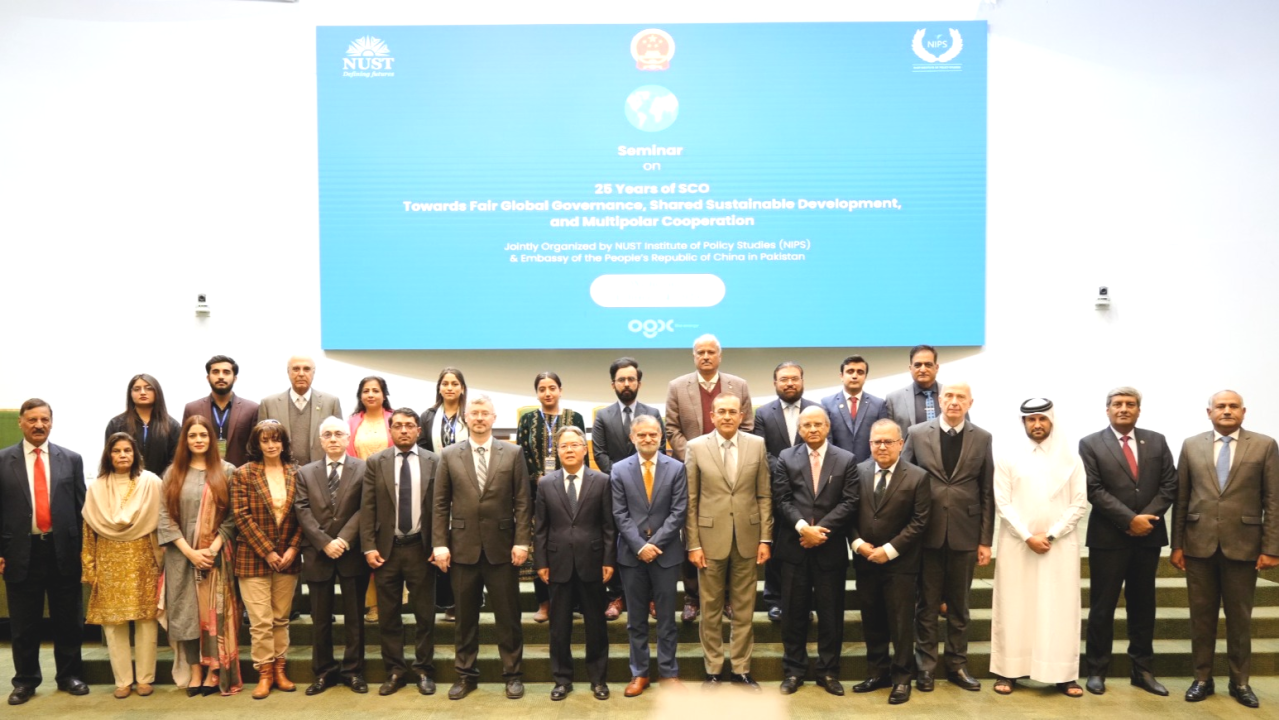
𝐍𝐔𝐒𝐓–𝐂𝐡𝐢𝐧𝐞𝐬𝐞 𝐄𝐦𝐛𝐚𝐬𝐬𝐲 𝐒𝐞𝐦𝐢𝐧𝐚𝐫 𝐂𝐨𝐦𝐦𝐞𝐦𝐨𝐫𝐚𝐭𝐞𝐬 𝟐𝟓 𝐘𝐞𝐚𝐫𝐬 𝐨𝐟 𝐭𝐡𝐞 𝐒𝐡𝐚𝐧𝐠𝐡𝐚𝐢 𝐂𝐨𝐨𝐩𝐞𝐫𝐚𝐭𝐢𝐨𝐧 𝐎𝐫𝐠𝐚𝐧𝐢𝐳𝐚𝐭𝐢𝐨𝐧
-Share this story:
Islamabad, February 4 — The NUST Institute of Policy Studies (NIPS), in collaboration with the Embassy of the People’s Republic of China in Pakistan, hosted a high-level seminar marking the 25th anniversary of the Shanghai Cooperation Organization (SCO). Held under the theme “25 Years of SCO: Towards Fair Global Governance, Shared Sustainable Development, and Multipolar Cooperation,” the event convened distinguished diplomats, veteran policymakers, think tank leaders, scholars, researchers, and students to reflect on the SCO’s evolving regional and global role.
Beyond being a commemorative gathering, the seminar served as a strategic dialogue platform highlighting the SCO’s growing relevance in shaping inclusive governance, sustainable development, and cooperative security in an increasingly multipolar world.
NUST’s Vision for Regional Cooperation and Knowledge Leadership
Opening the seminar, Rector NUST, Dr. Muhammad Zahid Latif, emphasized NUST’s position as Pakistan’s flagship institution in knowledge production, technological innovation, and human capital development. He highlighted the university’s active engagement with SCO initiatives aimed at strengthening regional trust, sustainable economic growth, and multilateral collaboration.
Dr. Latif also acknowledged the support of the Chinese Embassy for co-organizing the event and appreciated the Ministry of Foreign Affairs Pakistan for coordinating with the SCO Secretariat and arranging the keynote video message from SCO Secretary-General H.E. Nurlan Yermekbayev.
Underscoring the enduring relevance of the “Shanghai Spirit”—mutual trust, equality, consultation, and shared development—he noted SCO’s achievements in:
- Counter-terrorism cooperation through the Regional Anti-Terrorist Structure (RATS)
- Advancements in the digital economy and green energy
- Major regional connectivity projects, including the China–Kyrgyzstan–Uzbekistan Railway and the China–Europe Railway Express
These initiatives, he stated, collectively contribute to a more balanced and just international order.
China’s Perspective: Multilateralism and Global South Representation
H.E. Jiang Zaidong, Ambassador of China to Pakistan, highlighted the importance of the Global Governance Initiative in strengthening multilateral cooperation and ensuring stronger representation for the Global South.
He described the SCO as a model framework for regional collaboration amid global uncertainty, guided by the Shanghai Spirit and grounded in mutual respect and shared prosperity.
Ambassador Jiang reaffirmed China–Pakistan relations as a cornerstone of:
- Regional peace and stability
- Economic integration and connectivity
- Technological innovation and digital transformation
- Coordinated security cooperation
He called on SCO member states to deepen collaboration against terrorism, separatism, and extremism, expand trade and innovation partnerships, and uphold an inclusive international order rooted in international law.
Russia’s View: Strategic Stability in a Competitive World
Offering insights into contemporary geopolitics, H.E. Albert P. Khorev, Ambassador of the Russian Federation to Pakistan, emphasized the SCO’s critical stabilizing role in an era of intensifying great-power competition.
He described the organization as a unique, inclusive diplomatic platform enabling constructive engagement among member states, observers, and dialogue partners—thereby reducing risks of unilateral escalation.
Ambassador Khorev also highlighted SCO’s importance in addressing regional security challenges, particularly the Afghanistan situation, noting that effective use of the RATS framework could help manage evolving security dynamics across the region.
SCO’s Expanding Global Footprint
In a pre-recorded keynote message, SCO Secretary-General H.E. Nurlan Yermekbayev underscored the organization’s growing influence, now encompassing 27 countries across multiple cooperation formats.
He highlighted:
- The SCO Development Strategy 2035
- Proposals for a SCO Council on Sustainable Development
- Integrated collaboration across political, security, economic, scientific, and cultural domains
These initiatives, he noted, align closely with the United Nations Sustainable Development Goals (SDGs) and support the emergence of a just, inclusive, and prosperous multipolar global order.
Pakistan’s Commitment to Peace, Connectivity, and Development
Delivering the keynote as Chief Guest, Ambassador Nabeel Munir, Special Secretary (UN), Ministry of Foreign Affairs Pakistan, reaffirmed Pakistan’s dedication to regional peace, connectivity, and sustainable development within the SCO framework.
He highlighted the urgency of collective regional responses to converging global crises, including:
- Ongoing humanitarian challenges in Gaza and IIOJK
- Climate-induced displacement
- Regional economic instability, including inflationary pressures in Iran
Encouraging youth and emerging leaders, he stressed the importance of knowledge, innovation, and principled cooperation in building resilient partnerships and a fair multipolar future.
NIPS Perspective: Structural Shifts in Global Governance
DG NIPS, Dr. Ashfaque Hasan Khan, analyzed the transition from a unipolar to a multipolar international system, positioning the SCO as a consensus-driven and equitable platform representing:
- Nearly half of the world’s population
- Approximately one-quarter of global GDP
He emphasized SCO’s foundational principles of sovereign equality, consensus decision-making, and protection of Global South priorities, alongside institutional milestones such as:
- Prospects for a SCO Development Bank
- Expanding cooperation in transport, energy, trade, and green development
Engaging Dialogue and a Successful NIPS-Led Initiative
The seminar concluded with an interactive Q&A session, where participants discussed:
- The necessity and feasibility of a SCO Development Bank
- SCO’s capacity to counter cross-border terrorism
- Broader issues of collective regional importance
Participants widely appreciated the NUST Institute of Policy Studies (NIPS) for successfully organizing another high-impact international event, reinforcing its role as a leading platform for regional dialogue, policy discourse, and multilateral engagement.
Looking Ahead: SCO at 25 and Beyond
As the Shanghai Cooperation Organization enters its next phase of evolution, the seminar underscored a shared vision of:
- Fair global governance
- Sustainable and inclusive development
- Multipolar cooperation rooted in mutual respect
Through collaborative academic, diplomatic, and policy engagement, institutions like NUST and NIPS continue to shape conversations that matter—advancing regional harmony, global stability, and a more equitable international future.